
HWA Predator Beetles
Biology and Behavior

Laricobius nigrinus, a predator beetle from the Pacific Northwest, feeds vigorously on Hemlock Woolly Adelgid throughout the winter months. L.nigrinus, otherwise known as “Little Lari” causes disturbance of HWA populations after establishment. (see controlled studies). Laricobius females predate on adelgids before depositing their eggs into HWA ovisacs in the late winter months. Larcobius larvae will develop through 4 instar stages before dropping to the forest floor to pupate and eventually emerge as adults in the fall (view studies on L.nigrinus synchrony & predation).
HWA’s Natural Enemy

Laricobius nigrinus larvae (4th instar) complete their development through the winter on HWA ovisacs
Laricobius nigrinus is a keystone predator of HWA in the Pacific Northwest. see top-down predation studies on efficacy. Thankfully, L.nigrinus is successfully establishing on east coast as well. To date, over 450,000 L.nigrinus beetles have been released in eastern forests (see predator release map).


Electron photo of 4th instar laricobius nigrinus larvae
Laricobius beetles are strong fliers, capable of traveling 2-4 km in a single season in search of their prey. Once L.nigrinus. adults emerge from the soil, they use a combination of visual and olfactory senses to locate HWA. Research suggests they may use specially adapt chemoreceptors to locate hemlock trees under attack by HWA. After locating a population of HWA, L.nigrinus predates on HWA throughout the winter until they are ready to begin the next generation of predator beetles. Females leave their eggs behind, nestled into the wool of HWA, where they develop into larvae which will consume the remaining adelgids leftover from the previous generation until they have reached maturity.
What Makes L.nigrinus the Perfect Predator?
Laricobius nigrinus is a specialist predator, preying only adelgids. It has evolved alongside Hemlock Woolly Adelgid in the Pacific Northwest and adapted to its lifecycle. L.nigrinus's phenology is perfectly synchronized with HWA’s development cycle. While Hemlock Woolly Adelgid has 2 generations per year (winter and summer), the winter generation (sisten) does the majority of damage to eastern hemlocks. Why? HWA, being an invasive species, has no native predators to keep its winter generation in check on the east coast. Thus, its population runs rampant during the winter months. L.nigrinus is critical to controlling populations of Hemlock Woolly Adelgid because it predates on HWA during the winter months (October-April). While most arthropods are hibernating in the soil, Laricobius nigrinus is busy munching away on Adelgids.
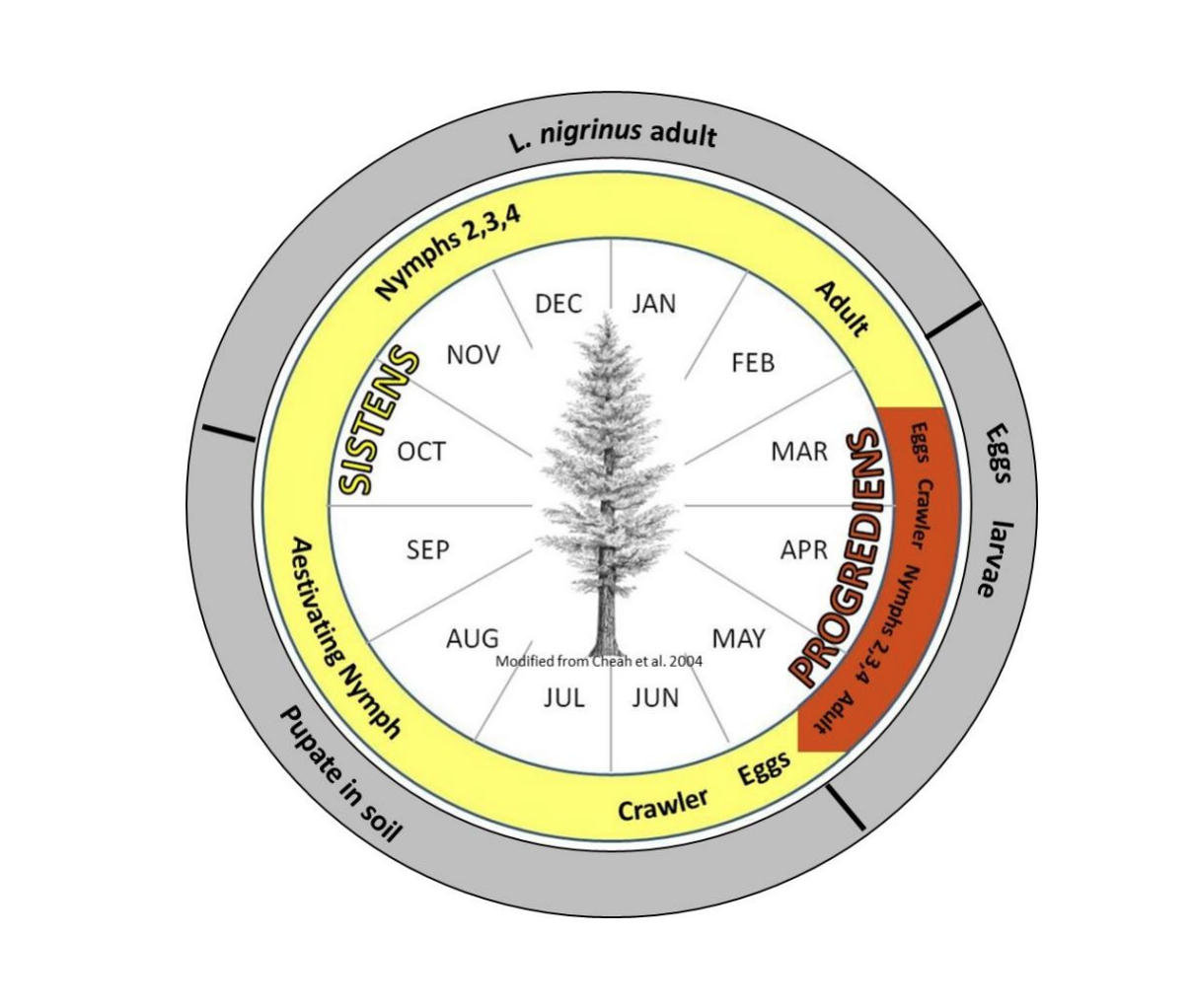
Original diagram, Cheah et al. (2004), modified by Lauren Michelle Gonzalez